
- All
- Product Name
- Product Keyword
- Product Model
- Product Summary
- Product Description
- Multi Field Search
Views: 0 Author: Site Editor Publish Time: 2026-03-13 Origin: Site


Choosing the right rechargeable battery for a solar power system can make or break your energy setup. Pick the wrong one, and you're dealing with frequent replacements, inconsistent power delivery, and mounting costs. Pick the right one, and your system runs reliably for years—even in tough conditions.
This guide breaks down everything you need to know about solar power rechargeable batteries: the different types available, how they compare, what specs actually matter, and which option stands out for large-scale or off-grid applications. By the end, you'll know exactly what to look for before making a purchase.
Not all rechargeable batteries are built for solar applications. Solar systems charge and discharge irregularly—energy input depends on sunlight, which fluctuates throughout the day and across seasons. A solar-ready battery needs to handle this gracefully.
Key characteristics include:
Deep cycle capability — the ability to discharge to a low state of charge and recharge repeatedly without significant degradation
High charge acceptance efficiency — the battery should absorb energy quickly during peak sunlight hours
Wide operating temperature range — solar setups are often outdoors, exposed to heat and cold
Low self-discharge rate — especially important for backup and off-grid systems
Maintenance tolerance — remote installations need batteries that don't require regular upkeep
There are four main types of rechargeable batteries used in solar power systems. Each has its strengths and trade-offs.
The oldest and most affordable option. Reliable, but requires regular maintenance—you need to top up the electrolyte periodically and ensure the battery is installed upright in a well-ventilated space. Not ideal for remote or hard-to-access locations.
A sealed lead-acid variant that uses fiberglass mats to hold the electrolyte. Maintenance-free, spill-proof, and handles moderate deep cycling. A solid mid-range option for residential solar setups.
Gel batteries use a silica-based gel electrolyte instead of liquid acid. This makes them more resistant to vibration, temperature extremes, and deep discharge. They're particularly well-suited for off-grid and outdoor environments where conditions are unpredictable.
The premium choice. Lightweight, long-lasting, and highly efficient—but significantly more expensive. Best for applications where weight and space are constraints, or where a very long lifespan justifies the upfront cost.
Feature | Flooded Lead-Acid | AGM | Gel | Lithium-Ion |
|---|---|---|---|---|
Maintenance | High | Low | None | None |
Deep Cycle Capability | Moderate | Good | Excellent | Excellent |
Temperature Tolerance | Poor | Moderate | Excellent | Moderate |
Vibration Resistance | Low | Moderate | High | High |
Lifespan (cycles) | 300–500 | 400–700 | 500–1,000+ | 2,000–5,000 |
Best For | Budget installs | Residential | Off-grid/Remote | Premium systems |
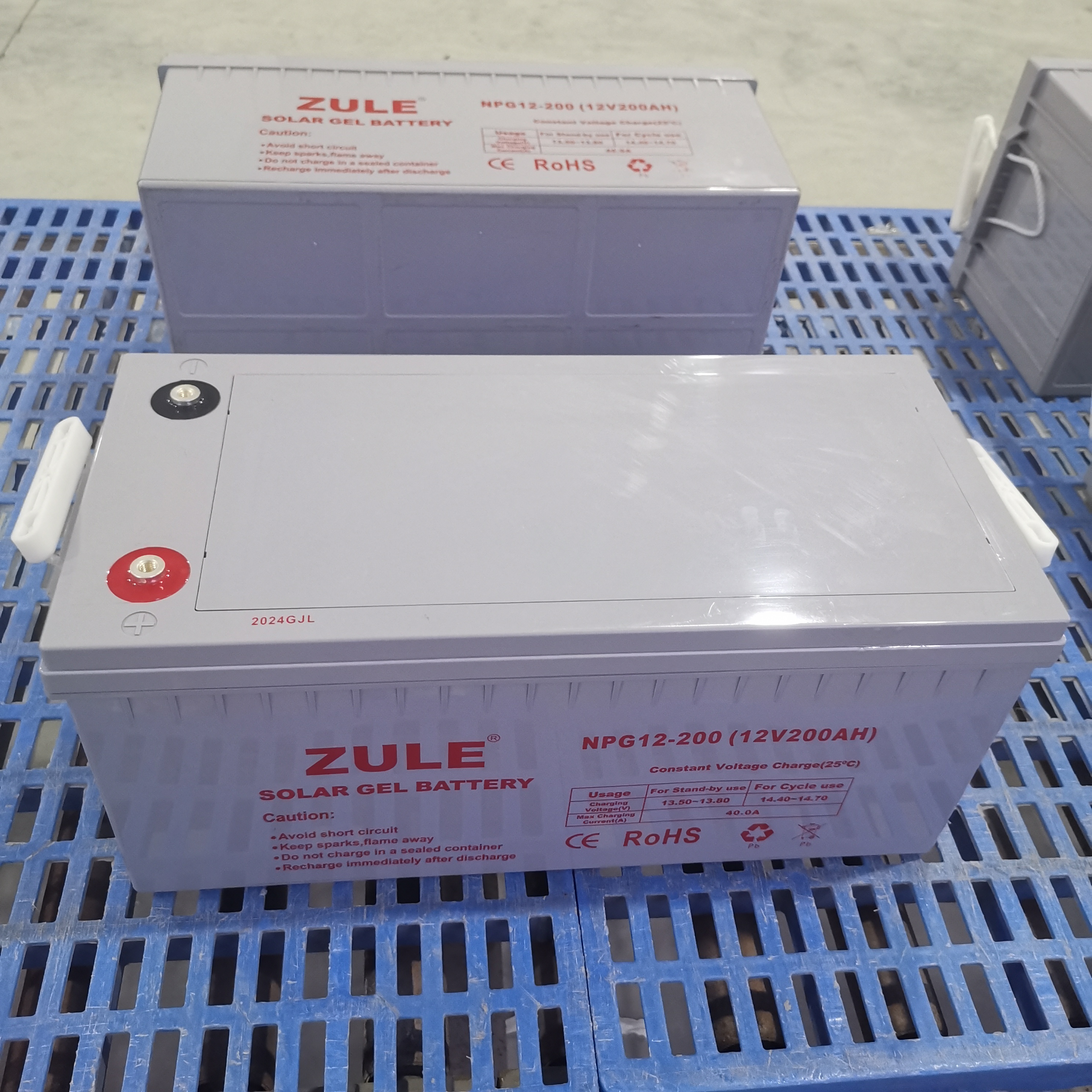
Among the solar rechargeable batteries listed above, gel batteries occupy a sweet spot that's often overlooked. They deliver deep cycle performance and resilience that flooded and AGM batteries can't match—at a fraction of the cost of lithium-ion.
The gel electrolyte (a mixture of sulfuric acid and silicon-based gel) doesn't spill, doesn't gas, and won't stratify the way liquid electrolytes do. This means the battery performs consistently across its lifespan, even when partially charged or discharged repeatedly.
For solar systems in remote areas, harsh climates, or large-scale installations, these advantages are significant. There's no need for routine maintenance checks, no risk of acid spills, and no performance cliff when temperatures swing.
For large-capacity solar storage, the ZULE 12V 250AH Solar Gel Battery is a standout option. Manufactured by Foshan Juli New Energy Technology Co., Ltd., it's engineered specifically for demanding off-grid and outdoor environments.
Specification | Details |
|---|---|
Rated Voltage | 12V |
Rated Capacity | 250AH |
Battery Type | Sealed GEL (VRLA) |
Weight | 66kg |
Electrolyte | Silica gel / sulfuric acid |
Application | Solar, RV, outdoor energy storage |
Uninterrupted power delivery. During daylight hours, solar panels charge the battery through an intelligent charge and discharge controller. After dark—or on overcast days—the battery takes over, providing continuous power to connected loads. This makes it suitable for 24/7 applications like remote data centers, server rooms, and critical infrastructure.
Built for remote installations. Off-grid sites in mountainous areas or isolated industrial zones don't have the luxury of regular maintenance visits. The sealed, maintenance-free design of this gel battery eliminates that problem entirely. There are no fluid levels to check, no venting systems to monitor.
Scalable capacity. The 250AH design supports modular expansion. Multiple units can be combined into large battery banks, making it adaptable for both small off-grid cabins and large-scale commercial energy storage systems.
Cost-effective over time. While gel batteries carry a slightly higher upfront cost than standard flooded lead-acid models, their longer cycle life and lower maintenance requirements reduce total cost of ownership significantly. Compared to lithium-ion batteries—which can cost two to three times more—they offer a compelling balance of performance and value.
Environmentally responsible. The battery uses non-toxic materials and produces no harmful gas emissions during normal operation, aligning with circular economy principles.
With so many options on the market, these are the factors that should guide your decision:
1. Capacity (Ah)
Match the battery's amp-hour rating to your daily energy consumption. A 250AH battery at 12V stores 3,000Wh (3kWh) of energy—enough to power essential loads through the night in most off-grid setups.
2. Voltage
Most small solar systems run on 12V or 24V. Larger installations may use 48V configurations. Make sure your battery bank voltage matches your inverter and charge controller.
3. Depth of Discharge (DoD)
Gel and lithium batteries can typically be discharged to 80–100% of their capacity. Lead-acid variants should stay above 50% to preserve lifespan.
4. Temperature Range
If your installation experiences extreme heat or cold, gel batteries are among the most temperature-tolerant options available.
5. Cycle Life
Consider how many charge/discharge cycles the battery is rated for. A battery with 800+ cycles will outlast a 400-cycle alternative by years in daily-use applications.
Can I use regular rechargeable batteries for solar storage?
Standard rechargeable batteries (like those used in consumer electronics) aren't designed for deep cycling or high-capacity storage. Always use batteries specifically rated for solar or deep cycle applications.
How many solar rechargeable batteries do I need?
This depends on your energy consumption, the number of sunless hours you need to cover, and your desired depth of discharge. A basic calculation: divide your daily watt-hour consumption by the battery voltage, then account for DoD.
Do gel batteries need a special charger?
Yes. Gel batteries require a charger or charge controller with a gel-specific charging profile. Overcharging can permanently damage the gel electrolyte.
How long do solar gel batteries last?
With proper care and charging, quality gel batteries can last 5–10 years depending on cycle frequency and environmental conditions.
A solar panel captures energy. An inverter converts it. But the battery is what makes your system reliable when the sun goes down. Choosing the right solar power rechargeable battery—one that matches your capacity needs, environment, and budget—determines how dependable your entire setup will be.
For off-grid systems, remote installations, and large-scale energy storage, deep cycle gel batteries like the ZULE 12V 250AH offer a proven, cost-effective solution. Explore the full range of solar rechargeable batteries at zule-battery.com to find the right fit for your system.
